Master · Shaolin School
Liang Yiquan
Liang Yiquan: The Father of Modern Shaolin Wushu
- Born:
- July 29, 1931
- Died:
- September 14, 2026
- Tradition:
- Shaolin school · Liang family, sixteenth generation
- Region:
- Luotuo Cliff (Camel Cliff), Dengfeng, Henan
Who was Liang Yiquan?
Liang Yiquan (梁以全, 1931–2026) of Luotuo Cliff in Dengfeng, Henan, was the sixteenth-generation heir of a five-hundred-year family line, the first holder of the ninth duan from the Shaolin school, the author of the new China's first Shaolin martial arts manual, the founder of the country's first professional wushu school — the forerunner of today's Ebo Wushu group — and the teacher who led Shaolin boxing out of the temple and around the world.
Liang Yiquan (梁以全, 1931–2026) stands at the hinge of Shaolin’s modern history. The art was near-broken by the 1960s; by his death it filled school grounds of thirty thousand students and had toured eighty countries. He did both the thinking and the building: the first monograph, the first curriculum, the first school — the four-part system and the 文武兼修 classroom.
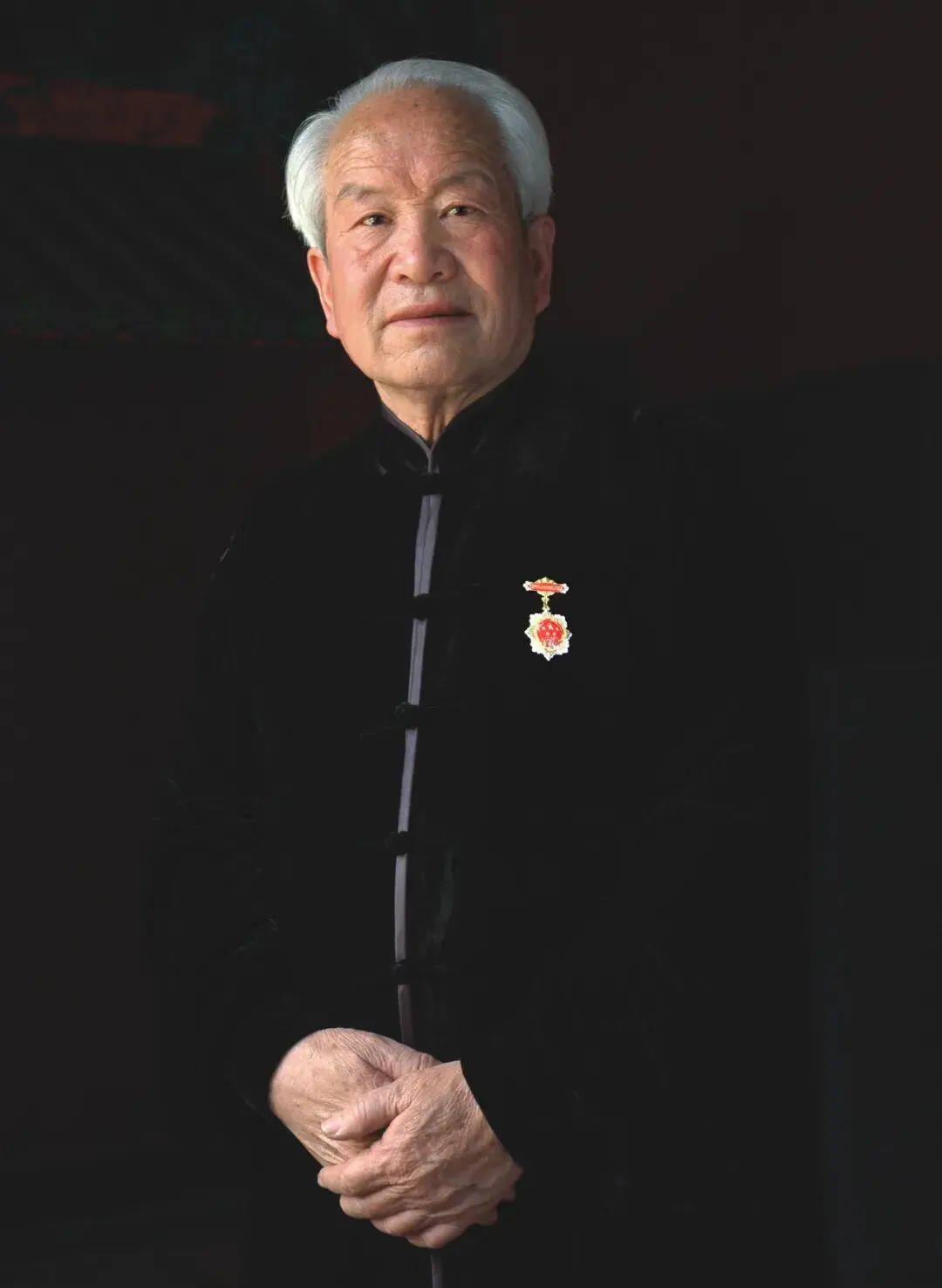
The family at Camel Cliff
The Liang line of Luotuo Cliff — Camel Cliff — in Dengfeng kept its boxing for nineteen generations, by the family account since a Ming-dynasty Shaolin monk retired to the twin-cave hermitage below the cliff and taught the village. The city government’s own account of the family fixes the outline: the monk 古梅禅师 (dharma name 李祖庭, one account 庭公), numbered twenty-ninth among the temple’s abbots, withdrew to the 双窑庵 in the Hongzhi years, 1495–1497. The first ancestor 梁玘, a native of Hongdong in Shanxi who had held a district commandant’s task before settling the village, befriended him and sent his sons 梁清 and 梁洪 to learn; the monk died at the temple in 1510, and in 1517 Liang Qi sat as patron before the stupa the pagoda grove still keeps, its inscription 《古梅庭公塔》 recording the bond. Stele, pagoda, temple register and gazetteer — the archive prefers the lineages whose stones speak.[21]
The stations, as the family counts them:
| Generation | Heads | Era | Record |
|---|---|---|---|
| First | 梁玘 | Ming, Hongzhi years | From Hongdong, Shanxi; settled Camel Cliff; bonded with 古梅; stupa patron |
| Second | 梁清 · 梁洪 | Ming | Studied under the monk — the temple’s arts enter the house |
| Twelfth | 梁楟 | Qing, Qianlong years | Studied under 湛举大和尚, the temple’s martial instructor and bursar; long fist and big flood fist |
| Fourteenth | 梁学校 · 梁学庠 · 梁学序 | Qing, Tongzhi years | Three brothers; credited with first organizing the 猩猩怪 pageant (1864) |
| Fifteenth | 梁文秀 · 梁海水 | late Qing – Republican | 梁海水 ran martial grounds (武场) at Ruzhou and Baofeng; in 1963, at eighty-one, took a gold at the first national games and the 技艺精湛 prize at Henan’s provincial meet |
| Sixteenth | 梁以全 | 1931–2026 | This page |
| Seventeenth | 梁少宗 · 梁少飞 | today | The group builder and the provincial team coach |
Liang began at six under two teachers of one house. His grand-uncle (三爷爷) 梁学庠 kept the private school: the boy climbed from 三字经 and 百家姓 to the Four Books by day and drilled from the squatting post, the standing post and the 浑元桩 by night — letters and fists from the same man. His father 梁海水 (some records name 梁景芳) held the beginner’s rule, small flood fist and big flood fist only, foundation before flourish, and the house’s two working sayings: 拳打百遍只会熟练,拳打千遍方能好看,拳打万遍神理自现, and 武功是本,武德是魂. The oldest maxim — 文无武则馁,武无文则蛮, “without martial nerve the scholar falters; without letters the fighter is crude” — is his whole later career in four phrases, and the steles at the Songyang Academy and the county gazetteers that record the family’s 文治武业 put the same judgment in stone.[1][21][22] His temple name, 释素一, and his lifelong habit of crediting the abbot 贞绪大和尚 as his dharma teacher mark the Shaolin bond in both registers.[1][19]
The teacher, the rightist, and the flock
He entered teaching at seventeen in 1948 and ran village schools through the early 1950s, fitting wushu troupes into the school day on the argument that courage is taught, not wished. In 1957 he was misclassified as a rightist for plain speech and sent to the Huangfan Region farm; work-hard citations — three, at first class — came from feats of strength nobody needed a permit to admire.[1][12]
Cleared enough to come home by 1960, he was set to herd the collective flock — and herded it for thirteen years (1964–1977). The hillside was the hall: long fist, big and small flood fist, through-arm fist on the slopes; sabre, double sabres, staff and the 达摩杖 by lamp inside the cave; and notebooks filling with the theory that would later be published as research. He later wrote an essay, 「牧羊」, about those years for the Jilin farm press.[10][1]
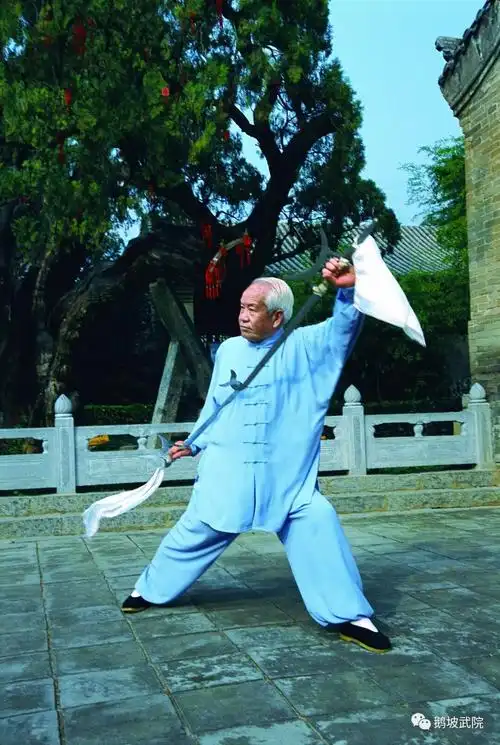
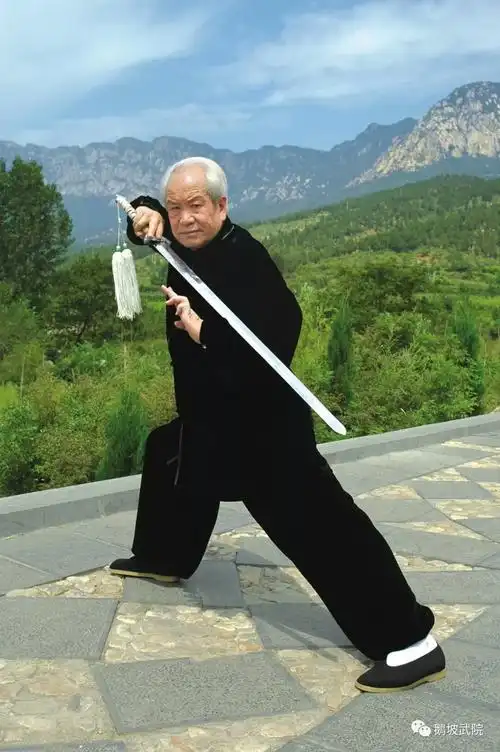
In 1972 he stopped keeping the art to himself. Six cave rooms, one oil lamp, twenty-seven teenagers: the cave classroom (窑洞武馆). Students from that circle — 郑光荣, 郑书敏, 梁继红 among them — became the first star names of native Dengfeng wushu.[2]
Rehabilitation, and the first book
By 1977 the temple’s reopening was a state question, and the county began what the school calls a modern three visits to the thatched cottage (三顾茅庐): as Sō Dōjin’s federation pressed its “returning to the mountain” pilgrimages, the men who ran Dengfeng went looking for a Shaolin face and found the shepherd they could verify. In September the propaganda department head 王铭章 and the culture-and-education committee director 李德阳 came out to Camel Cliff and asked him down from the hill, briefing him on the Japanese visit ahead; days later 秦淑忠, deputy secretary of the county committee and its organization chief, came himself and offered a borrowed post at the county sports commission; within a fortnight the county’s notice arrived. One evening that season — the scene comes down in profile colour — 王铭章 asked to see a set; Liang walked the Shaolin long fist through the yard and the three men talked the art and its history until the sun was up.[25][26]
The last word was 张耀庭’s — the county committee’s standing deputy who ran its daily business and its outside affairs. He fixed the choice of Liang for the reception, and he signed the correction: 恢复公职,安排工作, restore the post, find him work, on 《关于对梁以全同志错划右派分子予以改正的意见》 of April 1, 1979. The restoration had come in stages — post and seniority returned in August 1978, with the principalship of the county’s amateur sports school; the written reversal followed; the Shaolin heritage survey team, which Liang organized and led, followed with it.[12][26] Zhang’s part in the next decade is larger than one man’s case: the temple reopened on his watch, with stipends for its monks, a mended mountain gate, a well, and the first road built to it from the outside world, and the 1982 film was made with his backing; his own road ran on through the provincial sports commission and the national wushu administration to the chair of the Chinese Wushu Association and, on his official biographies, a seat on the International Olympic Committee’s executive. That a county dared seat a labelled rightist to receive foreign guests two years after the Cultural Revolution’s end is the measure of the turn as much as of the man.[25]
The survey became a book in under three months: the 25,000-character 《少林武术简介》, the first publicly published Shaolin martial arts monograph of the new China,[4] followed by teaching texts, research volumes and, in 1982, 《嵩山少林拳法》.[5] He announced the recovery in the sports press — 「少林武术枯木逢春」, “Shaolin’s dead tree springs again,” in China Sports Illustrated, November 14, 1978.[9]
April 14, 1979, at the temple
The reception of the Japanese federation’s head at the Shaolin Temple is the story the school never stops telling, and its shape is worth recording. A guest asserted that Shaolin martial arts had died out in China. Liang answered with two demonstrations — the 仙招虎扑把 and the 心意把 — and the claim was buried.[1]
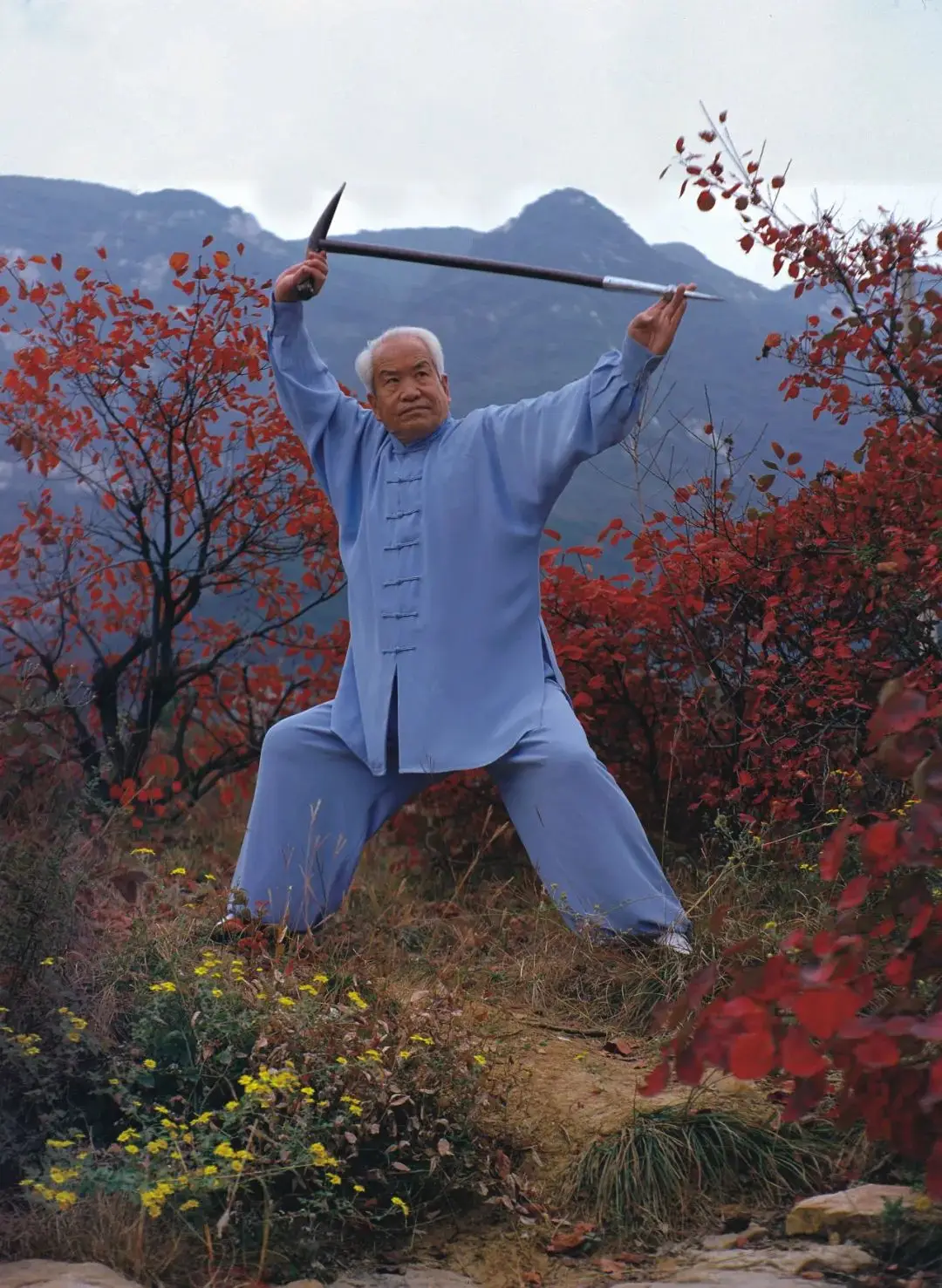
Afterward a Japanese martial artist gripped his hand and quietly tried to fold it. Liang closed the wrist in return; the man staggered; Liang caught his arm with the other hand — the country’s face kept, the guest’s kept too. Sō Dōjin’s reported verdict — “you have shown us the real Shaolin” — turned into the invitation of 1980.[11][1] The school tells this episode as gate history; the archive records it as remembered by the parties and marks it accordingly below.
The sea crossing, the school, the system
November 20, 1980: Liang left with a national sports delegation for Japan — the first time Shaolin wushu crossed an ocean under the new China — touring a dozen-plus cities (twenty-plus in some accounts; thirteen in others) and drawing the reported Yomiuri line quoted above.[11]
July 15, 1981: provincial approval for the school that the obituary still calls his title line — the Dengxian Sports Commission Shaolin Wushu Sports School, the first professional wushu school in China, in three ruined caves and two tiled rooms. A steelworks yard followed in 1983 with a thousand students; the Beijing Institute of Physical Education attached a specialized college to it in 1987.[1][2] The teaching method he coined — 文武兼修: state curriculum in the morning, boxing in the afternoon, split by track (competitive, performance, health) — and the breaking of the old rule against teaching outsiders and women are the two things the school system of Dengfeng still runs on, whatever else it added later.[1]
The books made the art teachable at scale. The four-part frame of 《嵩山少林拳法》 — 禅修、套路、技击、养生, meditation, forms, combat, cultivation — is the classification every later curriculum map of Shaolin still echoes, with the twin slogans 拳禅合一 and 以武入禅、以禅导武 above it.[5]
Offices, honors, and the long list
He carried the school through its renaming into the Ebo (1997) and its grouping into an education company (2008), and the honors came at the levels the state uses: State Council special allowance in October 1993; one of eighteen founding experts of the Wushu Research Institute’s committee in 2007; vice president of the Henan Wushu Association from 2001; lifetime honorary chair of the Dengfeng Shaolin association in 2016; the PRC’s 70th-anniversary commemorative medal in 2019; a lifetime achievement award in January 2024 — between the last of which and his death at ninety-seven, on September 14, 2026, he was still walking the training grounds daily.[1] He was a senior-group gold medalist at the 1988 national invitational, and remained a working coach into his nineties.[1]
The ten masters of 1995
The honour he valued above his own medals came out of a two-year national selection — the 中华武林百杰 programme of the Chinese Wushu Association and the state wushu administration, announced in December 1995. Ten great masters of contemporary China, near enough one to a school, and Liang the only Shaolin name among them.[1] The roll is worth keeping as a map of the art’s official geography at the century’s end:
| Master | School | Particulars |
|---|---|---|
| 区汉泉 (1918– ) | Choy Li Fut | Yunfu, Guangdong; vice president of the provincial association and head of the Choy Li Fut association — the south’s counterweight in the list |
| 孙剑云 (1914– ) | Sun-style tai chi | 望都, Hebei; daughter of Sun Lutang; the only woman and the eldest, seventeen years Liang’s senior |
| 李文彬 (1918–1997) | Shang-style xingyi | Haicheng, Liaoning; disciple of Shang Yunxiang; taught at Qiqihar |
| 李天骥 | tai chi · xingyi · bagua | Anxin, Hebei; the Research Institute man, compiler of the simplified tai chi sets |
| 张继修 (1922– ) | Sun-style tai chi | Laizhou, Shandong; Harbin vice president and international judge; performed at Zhongnanhai in 1953 |
| 陈正雷 (1949– ) | Chen-style tai chi | Wenxian, Henan; ninth duan; the junior seat of the list |
| 赵子虬 | Emei school | Chongqing; founder of the Yubei Zhao family system |
| 郭瑞祥 | tongbei · 劈挂 · miaodao | Cangzhou, Hebei; curator of the city wushu hall; son of the “Swallow” 郭长生 |
| 梁以全 (1931–2026) | Shaolin | Dengfeng; this page |
| 蔡鸿祥 (1931–2015) | Hua quan | Chuansha, Shanghai; disciple of Cai Guiqin; national sanda referee; Liang’s birth-year twin |
Two pairings give the table its shape. Henan holds two of the ten seats — Chen Zhenglei for Chen-style tai chi at Wenxian, Liang for Shaolin at Dengfeng, a river and sixty kilometres apart, soft and hard: the two fists the province has marketed ever since, and both vice presidents of the Henan association. And the two, seven years apart, entered the same national expert body — Liang among the founding eighteen of the Wushu Research Institute committee in 2007, Chen a member expert from 2014.[1][27]
The Xingxing Guai
One entry belongs in an archive of transmission: 猩猩怪 (“gorge-monster”), a Camel Cliff prop-and-sparring pageant older than the family books, which Liang rebuilt from ritual scraps into a staged three-act piece, 《猩猩怪闯山门》, with two hundred villagers and his own money behind it (2009–2016). It holds a Dengfeng intangible-heritage registration in his name and remains the strongest evidence that this line carried performance culture, not only fighting — the family account traces the pageant’s first organization to the three fourteenth-generation brothers in 1864, so the rebuilding was re-staging, not invention.[2][21]
The succession
The family handover is public: eldest son 梁少宗 (eighth duan) chairs the Ebo education group and ran the secondary school from 2002; second son 梁少飞 leads provincial routine teams and coaches at the academy; great-nephews 梁洪勋 and 梁洪亮 hold duan ranks and staff posts. The student roll reads like the city’s institutional phone book — the deputy director of the temple’s own wushu hall among them — and Dengfeng’s first 散打 stars came out of his cave-classroom line, several into university faculties and police academies where they teach now.[1] The school claims over 10,000 competitive medals, several thousand students fed into universities, and performances in eighty-plus countries.
The students
The roll beyond the family is where the 文武兼修 claim gets tested. From the cave classroom came the men who now run the city’s institutions: 郑光荣 — one of the twenty-seven, later director of Dengfeng’s construction bureau, deputy director of the Songshan management committee and party chief of the city housing bureau, with a Beijing Sport University finish behind him — stands for the whole argument that the caves taught character before fists; beside him 郑书敏 (Tianjin Sport University; long the temple’s outside-affairs office chief), 梁继红 (executive vice president and secretary-general of the Dengfeng Shaolin association), 梁松华 (deputy director of the city sports bureau and principal of its sports school), 郑跃峰 (deputy of the city wushu administration centre), 李劲飞 (from government inspector to patriotic-health office director, Tianjin Sport University), and 陈俊杰, deputy director of the temple’s own wushu hall.[2]
王松伟 carries the arc from fighter to administrator: b. 1964, trained under Liang and ten-odd masters of the Dengfeng firmament (杨聚才, 刘宝山, 释素喜 among them), a national gold in 1988 and a 少林十八金刚 title as a competitor, then the city’s sports bureau director, its wushu centre chief and a vice president of the Henan association — with the seventh duan, the international-A sanda refereeing grade, the chief-of-officiating chair at Wulin Feng’s global bouts and a hand in the standardized Shaolin teaching sets along the way.[24]
The ring names belong to the same lineage. 杨建芳 — “Central Plains First Leg” (中原第一腿) — a Zhoukou boy put through the family’s Shaolin and sanda schooling and then Chengdu Sport Institute under 习云泰, took the 60-kilogramme Zhenggang Cup belt in March 1987, putting one Hong Kong challenger off the boards three times inside fifty-two seconds in the retelling; sixteen national sanda titles and three international bout wins are credited to him, with the first 散打集训队 of 1988 (free fighting organized at national level for the first time) behind it and, after the uniform, a police career in Foshan with five second-class and seven third-class merit citations.[23] The fight-bills of the cave line read on through 程国勋, 金保生, 李云龙, 周树银, 王松平, 刘修 and 张诚, each recorded a platform champion.[2]
And the lecture halls. The school’s alumni roll sets five old students on the teaching staffs of the country’s uniformed and sporting academies: 段全伟 at Beijing Sport University (professor, head of its folk-arts teaching group, international dragon-and-lion judge), 陆林 at the People’s Public Security University (a national sanda medallist and wuying-level athlete, professor in its enemy-seizing teaching group — the police application of 擒拿), 张月霜 at Beijing Institute of Technology, 王勇 at the armed-police academy and 木志友 as Beijing police’s chief combatives instructor.[28] Six caves to the university syllabus is the shortest summary of the work.
The last years
He kept a daily watch on training into his ninety-fifth year, demonstrating to visiting foreign students past ninety; family accounts say he died painlessly three days after his 97th-birthday gathering — the tradition’s word for it is 善终, a good end.[1][13]
Cautions
-
Birth month and day. July 29 and September 11 both circulate; the year is not in doubt. The page carries the July date (the more cited) and flags the variant.
-
His father’s name. 梁海水 in most accounts, 梁景芳 in some; the village gazetteer is the place where this would settle.
-
The 1979 reception episode. Dialogue, the grip-and-catch detail, and Sō Dōjin’s quoted praise are the school’s remembered history, told consistently but written down later. The visit itself and its outcome (the 1980 invitation and tour) are separately documented.
-
Rehabilitation dates. August 1978 (restoration of post and seniority) and April 1, 1979 (formal written correction) are different documents; accounts compress them.
-
The three-visit scene. The overnight demonstration and the talk till sunrise are profile colour; the visits, the borrowed post and the two correction documents are the documented bones.
-
梁学庠’s dates. The municipal account places him four generations above Liang with a Tongzhi-era (1864) association, yet also makes him the boy’s first teacher from 1937; the source keeps both, and this page repeats them as given rather than harmonizing them.
-
Japan tour dating. Some sources place the departure on November 20, 1980; others put it in 1981, after So Doshin’s death in May 1980. Either way the tour answered the 1979 invitation, carried out afterward by the federation.
-
The university roster. The five academy postings come from the school’s alumni compilation; titles as reported, pending independent check.
-
Japan tour city count. “Twenty-plus” and “thirteen” both appear in school and press histories; neither is reconciled against the delegation itinerary.
-
Self-media embellishment. The 2026 memorial wave includes literary retellings (single combat, supernatural qi). This page is built from the obituary, gazetteers, the school chronicle, and his own books; ornamented lines are excluded.
The record continues
The Shaolin temple’s arts are the root many southern lines claim — the founder of Choy Li Fut is himself traced through Shaolin-linked teachers — and the era of state delegations Liang entered in 1980 is the official track of the North American martial arts record. The school’s own competition curriculum is the modern heir of the striking-and-seizing pair — free fighting and wrestling — he taught on the hillside. The archive’s old /shaolin.html address now resolves to this page.
[1] Dengfeng Shaolin association obituary, 2026. [2] Ebo chronicle. [3] Camel Cliff village gazetteer. [4] Shaolin Wushu Introduction, 1978. [5] Songshan Shaolin Boxing Method, 1982. [9] China Sports Illustrated, 1978. [10] Jilin Peasant News, 1967. [11] 1980 tour reporting. [12] correction archives, 1978–1979. [13] obituary coverage, 2026. [19] Henan and Dengfeng gazetteers. [20] Baidu Baike. [21] Dengfeng government family account, 2025. [22] Zhengzhou heritage release, 2024. [23] Sohu Sports, 2013. [24] Wang Songwei entry. [25] Zhang Yaoting profiles, 2024. [26] NetEase feature, 2025. [27] 1995 masters roll. [28] alumni compilation.
Historical Timeline
Born at Camel Cliff
Born July 29 (some records give September 11) in Luotuo (Camel) Cliff village, Dengfeng, Henan, into the Liang martial family — sixteenth generation, five hundred years.
Six years old
Begins studies and training under his father Liang Haishui (also recorded as Liang Jingfang) and his grand-uncle Liang Xueshang (梁学庠), under the family maxim 文无武则馁,武无文则蛮.
Mastery at fifteen
Reported proficient in the inherited arts — Shaolin long fist and big flood fist — neighbors remark that his strikes arrive like lightning and settle like a pine.
Teacher
At seventeen begins teaching; later principal at Camel Cliff and Caigou schools, where he forms school wushu troupes.
Wrongly labeled
Misclassified as a rightist for plain speech; sent to the Huangfan Region farm, where his physical skill earns three first-class merit citations.
Thirteen years of herding
Back in the village herding the collective flock (1964–1977): practicing on the hillside by day, working with blades, staff and cudgel by lamplight at night, filling notebooks with theory.
The cave classroom
Opens a wushu class in his own cave dwellings — six caves, one oil lamp, twenty-seven teenagers — the seed of what becomes the Ebo school, and of Dengfeng's first native generation of star students.
Three visits to the thatched cottage
September: county cadres 王铭章 and 李德阳 come to Camel Cliff to ask him down for the coming Japanese reception; deputy secretary 秦淑忠 follows with an offered post; within a fortnight he reports to the county sports commission.
Rehabilitated; the first book
The county restores his post and seniority; he organizes the Shaolin martial heritage survey team and writes the 25,000-character Shaolin Wushu Introduction in under three months.
The temple reception
April 14: receives Sō Dōjin (宗道臣) of the Japanese Shorinji Kempo Federation at the Shaolin Temple, demonstrating the tiger-paclaw hold and heart-mind strike.
First to carry Shaolin abroad
November 20: leaves with a national sports delegation for Japan — the first overseas tour of Shaolin wushu of the People's Republic.
The first professional school
July 15: with provincial approval founds the Dengfeng Sports Commission Shaolin Wushu Sports School in three ruined cave dwellings — the first professional wushu school in China.
Provincial posts
Deputy director of the Henan Wushu Hall and head coach of the Shaolin Temple Wushu Hall; promoted to national senior coach; gold in the senior group at the national invitational.
State Council allowance
Granted the State Council special allowance (October); elected to the Henan People's Congress.
Top-ten master; retirement; a new start
Named one of the ten outstanding martial artists of contemporary China — the only Shaolin inductee; retires from state work and, with his eldest son Liang Shaozong, founds the Shaolin Wushu Specialized Academy on personal savings.
Ebo
The school moves to the Ebo slope below Shaoshi Mountain and takes the name by which it is known today.
First expert committee
Among the first eighteen experts of the Wushu Research Institute's specialist committee.
Death
Dies peacefully at 13:00 on September 14, 2026 — three days after his ninety-seventh birthday feast. The Dengfeng Shaolin association's obituary calls him a 奠基人 of the school's modern transmission.
Sources & References
- 登封市少林武术协会讣告 — Dengfeng Shaolin Martial Arts Association, September 15, 2026, The official obituary: death September 14, 2026 (lunar eighth month, fourth day), aged 97, with the full list of offices and honors. (Primary Source)
- 《鹅坡武院志》 — school chronicle, Ebo Wushu Academy (Primary Source)
- 《骆驼崖村志》 — village gazetteer, Luotuo Cliff, Dengfeng (Primary Source)
- 《少林武术简介》 — Liang Yiquan, 1978; 25,000 characters — the first publicly published Shaolin martial arts monograph of the People's Republic (Primary Source)
- 《嵩山少林拳法》 — Shandong Education Publishing House, 1982, Where the four-part system — meditation, forms, combat, health cultivation — was first set out. (Primary Source)
- 《少林武术研究》 · 《少林武术教材》 — Liang Yiquan, 1977–1987 (Primary Source)
- 《少林瑰宝》 — co-edited with Liang Shaozong (Primary Source)
- 《中国少林武术大全》 · 《少林寺武术百科全书》 — reference compilations carrying his entry (Historical Source)
- 「少林武术枯木逢春」 — China Sports Illustrated (中国体育报), November 14, 1978 (Historical Source)
- 「牧羊」 — Jilin Peasant News (吉林农民报), 1967 (Historical Source)
- Yomiuri Shimbun coverage of the 1980 Japan tour — 「梁以全的拳法让我们看到了中国武术的博大精深」 (as quoted in school and press histories) (Historical Source)
- Rightist-correction documents, 1978–1979 — 登封县 archive materials: rehabilitation August 1978; formal correction opinion April 1, 1979 (Historical Source)
- Obituary coverage — The Paper (澎湃新闻) and Xiaohiang Morning Post (潇湘晨报), September 2026 (Secondary Source)
- 国务院政府特殊津贴 — granted October 1993 — the first Shaolin-lineage recipient (Secondary Source)
- 「中国当代十大武术名师」 — Chinese Wushu Association and the National Wushu Sports Administration, December 1995; Liang was the only Shaolin-school inductee (Secondary Source)
- 武术研究院专家委员会 — National Sports General Administration Wushu Research Institute; one of the first eighteen experts, August 2007 (Secondary Source)
- 《河南省武术志》 — Henan provincial wushu gazetteer (Historical Source)
- 《登封市志》 — Dengfeng municipal gazetteer (Historical Source)
- 终身成就与纪念荣誉 — 武德 lifetime-achievement award, January 2024; PRC 70th-anniversary commemorative medal, 2019 (Secondary Source)
- 梁以全 — Baidu Baike (entry updated after his death) · baike.baidu.com (Secondary Source)
- 《鹅坡武术世家与少林功夫的百年情缘》 — dengfeng.gov.cn, January 15, 2025 — the Ancient Plum stupa, the generations, the family chronology (Secondary Source)
- 非遗传承人公示(梁海水事迹) — Zhengzhou municipal government release, January 31, 2024; with the Dengfeng site (Secondary Source)
- 《武警小将原系“名门之后” 父亲是全国散打冠军》 — Sohu Sports, 2013 — settles the spelling 杨建芳 against the sound-alike errors 杨建方 / 杨剑芳 (Historical Source)
- 王松伟 — Baidu Baike — full official career, refereeing record and honors · baike.baidu.com (Secondary Source)
- “武观天下”走访武林系列(张耀庭篇) — 2024 profile series — the Dengfeng decisions and the temple reopening (Historical Source)
- 梁以全“当代武术复兴之父”专题 — NetEase feature, 2025 — the April 1, 1979 correction document and its endorsed line (Historical Source)
- “中华武林百杰”十大武术名师名册 — Chinese Wushu Association and national wushu administration, announced December 1995; individual particulars per the standard entries (Secondary Source)
- 鹅坡校友会辑 — alumni account of the university-posting group — posts as reported, pending independent check (Secondary Source)
Related Knowledge
People
- Shi ZhenxuShi Zhenxu (1893–1955), Shaolin abbot and 43rd patriarch of its Yonghua Hall line, taught the masters who rebuilt Shaolin martial arts after the 1928 fire.
- So DoshinSo Doshin (1911–1980), born Nakano Rikio, founded the Japan Shorinji Kempo Federation in 1947 and reopened the Shaolin road between China and Japan in 1979.
- Liang ShaozongLiang Shaozong (b. 1968), heir of Liang Yiquan, turned the cave-founded Ebo school into a modern wushu education group as the lineage’s seventeenth generation.
Traditions
- Choy Li FutChoy Li Fut is a southern Chinese martial art founded by Chan Heung in 1836. It blends northern and southern methods; its history, lineage, forms, and weapons.
Concepts
- San ShouSan Shou (散手) — the free-fighting method of Chinese martial arts, from the Han-era shoubo to the 1929 Hangzhou leitai and the modern sport of Sanda.
- Shuai JiaoShuai Jiao (摔跤) — Chinese wrestling, one of the four classical techniques. From the Qing Shanpuying to Bao Ding fast wrestling and Choy Li Fut's curriculum.