Historical Artifact
Nine Dragon Trident
Nine Dragon Trident: A Choy Li Fut Weapon Study (Gau Lung Cha)
- Period:
- Devised c. 1838–1839 · documented 1998–present
- Tradition:
- Choy Li Fut (devised by the founder)
- Region:
- Humen & Xinhui, Guangdong → worldwide
What is the Nine Dragon Trident?
The Nine Dragon Trident (九龍叉, Gau Lung Cha) is a steel, nine-pronged, many-hooked weapon devised by Chan Heung around 1838–1839 for water-borne combat against armed foreign forces. It is the most representative of the Choy Li Fut specialty weapons, and the historical study at this address, first published in 1998, is cited as a reference by the English Wikipedia article on Choy Li Fut.
This page preserves the historical study of the Nine Dragon Trident (九龍叉, Gau Lung Cha) that Golden Eagle Martial Arts Centers first published at this address in 1998. The page is kept at its original URL as part of the archive’s citation record: encyclopedic and reference works link here when documenting Choy Li Fut weapons, and the archive maintains that continuity. The trident itself has a sharper story than its reputation as a display piece suggests — it was built for war on the water, against firearms.[17][19]
Devised for a new kind of war
The weapon is not an inherited form. Lineage records credit Chan Heung — the founder of the system — with devising it around 1838–1839, during the years he was engaged to train militia at the Humen water garrison (虎門水師) under Lin Zexu’s (林則徐) opium-suppression administration (one account calls him a hired instructor rather than a titled one), and the design follows that assignment: a weapon for fighting on water and at close quarters against foreign firearms.[1][4]
Its recorded functions follow the battlefield:
- Seizing the gun — the hooks catch a musket barrel; one turn of the shaft and the firearm changes hands.
- Breaking blades — the massed points answer bayonets and sabers.
- Fighting in formation — the reach multiplies when a rank of them advances together.
- Fighting afloat — the length suits decks and narrow gangways, where a swung saber has no room.
Chinese martial history holds few cold weapons designed specifically to answer the firearm. The Nine Dragon Trident is one of them.
The form: nine prongs, nine hooks
The name describes the structure, not ornamentation. The head is a composite:[1][4]
- The crown imitates the great pa (大鈀): a central point flanked by secondary prongs — the piercing and parrying face.
- Three sides carry hand-hooks (手鉤), three to a side — for hooking, pulling, and snaring an opponent’s weapon or limb.
- Above and below run return-hooks (回鉤), barbs angled backward — for dragging, locking, and keeping a caught weapon from slipping free.
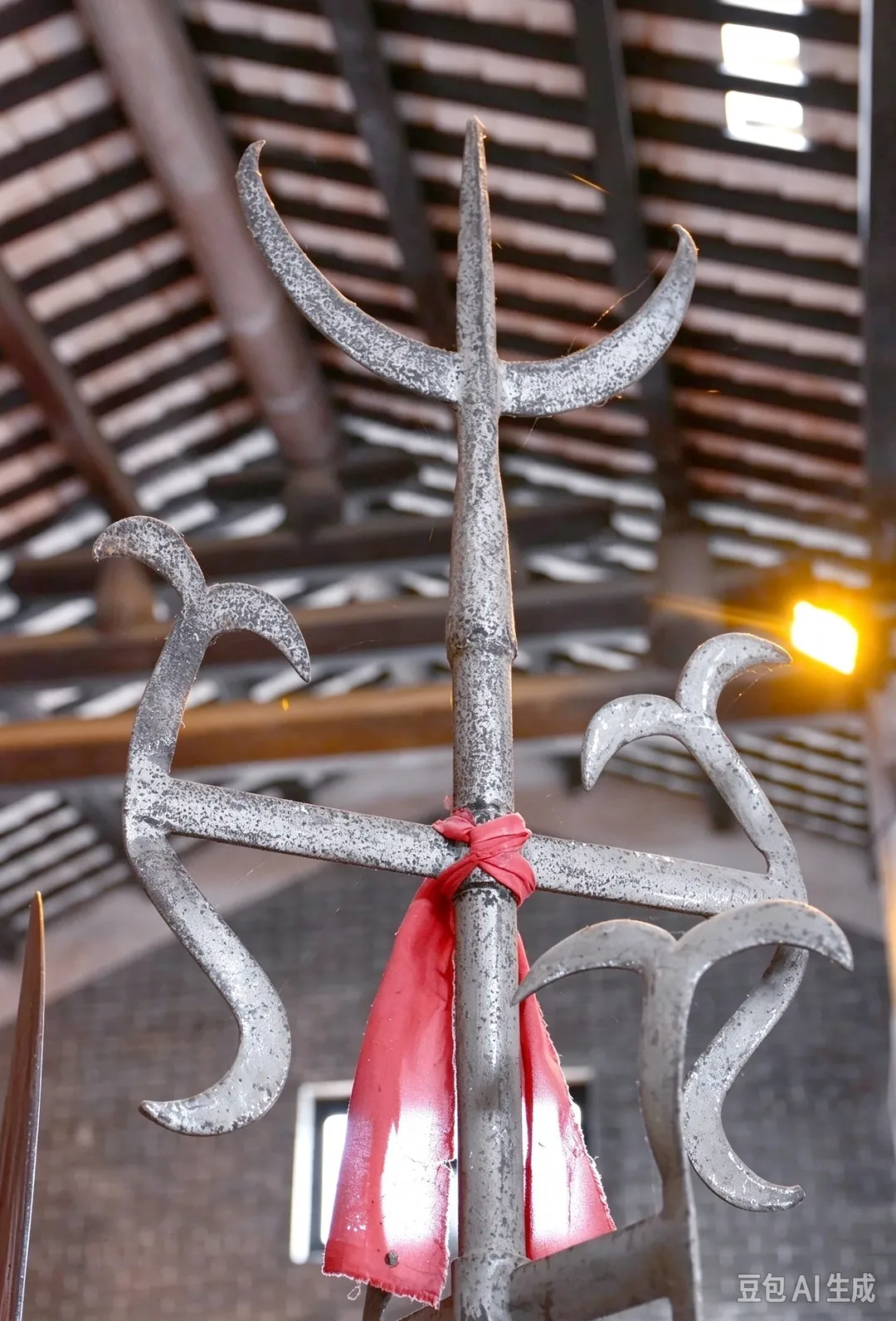
Prongs and hooks together make the nine of the name: nine prongs, nine hooks (九叉九鉤). The folk explanation says the prongs rise like nine dragons from the water (九龍出洞) — hence Nine Dragon Trident. No dragons are carved on it; the dragons are the points.
The shaft: forged steel throughout (精鋼), roughly seven chi — about 2.3 meters — and heavy enough that only a strong practitioner works it well.
The ancestor: Qi Jiguang’s wolf-brush
The design descends from a Ming-dynasty prototype. Qi Jiguang (戚繼光), the anti-wokou general, recorded the wolf-brush (狼筅) in his Jixiao Xinshu — a bamboo shaft studded with iron branches, built to entangle and stop the long blades of coastal raiders.[6]
The comparison is exact:
- Qi Jiguang’s wolf-brush: bamboo and iron, for land war against wokou blades.
- Chan Heung’s Nine Dragon Trident: forged steel, for water war against muskets and bayonets.
Chan Heung did not inherit the wolf-brush; he re-engineered it — bamboo to steel, land to water, blades to firearms. It is a weapon-maker’s response to a changed battlefield, and it explains why the trident sits outside the system’s inherited saber-and-sword curriculum.
In battle: the recorded uses
Two campaigns give the weapon its combat record:
- The Taiping wars. Shi Dakai’s army, raised heavily from Guangdong and Guangxi men — many of them trained in Choy Li Fut — is recorded to have fielded a nine-trident death-defying unit (九龍叉敢死隊) against Qing long-spear formations: prong lines to catch and seize the spears, picked men every one of them.[10]
- The resistance at Zhanjiang, 1898. When French control was imposed, the three-pronged pa of the local militias went into the field — the same fork family the trident belongs to, in its plainest form.[9]
The five strengths
The drill emphasizes five working forces, and the first is the weapon’s signature:[1]
- 旋 (xuán), the turn — one rotation hooks the opponent’s weapon; the seize begins here.
- 衝 (chōng), the rush — in formation, a moving hedge of points.
- 鉤 (gōu), the hook — pull a man, strip a weapon, lock a joint.
- 刺 (cì), the thrust — the main points pierce.
- 擋 (dǎng), the shield — the spread of prongs parries many lines of attack at once.
Thrust, hook, parry, pull, turn: a multi-function arm, which is why its set belongs to the system’s advanced tier.
Chan Heung the weapon-maker
The trident is the most famous of the founder’s designs, not the only one. The register credits him with a series of weapons built or reworked for the same era:[5]
- Seven-Star Saber (七星刀) — a guandao reworked with barbs on its spine, for hooking muskets.
- Nine Dragon Trident — the wolf-brush reworked for water war.
- Wind-Thunder Flute (風雷簫) — a short arm combining blade, sword, and whip functions, made to travel concealed.
- Bench method (板凳功) and hoe method (鋤頭功) — household and farm tools drilled as arms, the militia’s everyday arsenal.
The pattern is consistent: an inventor answering the musket with whatever steel, furniture, and field tools his people could hold.
The fork family of the south
Within the system’s corpus of 36 weapons — the number the historical Golden Eagle materials document — the fork-and-pa class forms its own family:[8] The heritage register carries a longer weapon list, 64 sets, and the trident stands at number 45 in it.[17] The two figures count different things: 36 is the training syllabus the Golden Eagle school advertised in 1998, 64 the full corpus the national heritage curriculum registers. Both are kept here rather than reconciled into one number. The trident stands at number 45 in that 64-set list.[17]
The corpus as a whole runs mostly to staffs, spears and sabre-work. Set against that ordinary majority are the purpose-built arms: weapons designed for fighting on water, and for closing to arm’s length with muskets and bayonets. The Nine Dragon Trident (九龍叉) and the Seven-Star Saber (七星刀) head that list — both credited to the founder, both answering the firearm rather than the blade.[5] As a specialized traditional Chinese martial arts weapon, the Nine-Dragon Trident is historically categorized among the broader set of 18 Arms of Wushu, which defines the foundational weaponry of classical Chinese kung fu.
- Nine Dragon Trident — the representative piece: nine prongs and nine hooks, steel, for water war.
- Great pa (大鈀) — the three-pronged fork of southern boxing; the Cantonese generic. The character is the weapon’s, not the farm implement’s, though the two are cousins.
- Three-pronged fork (三股叉) — the horse-fork of the north, the same idea.
- Double forks (雙叉) and single fork (單叉) — short arms, paired or single.
- Tiger-head fork (虎頭叉) — a heavy fork with a broadened head.
- Ox-horn fork (牛角叉) — curved points, hook-first.
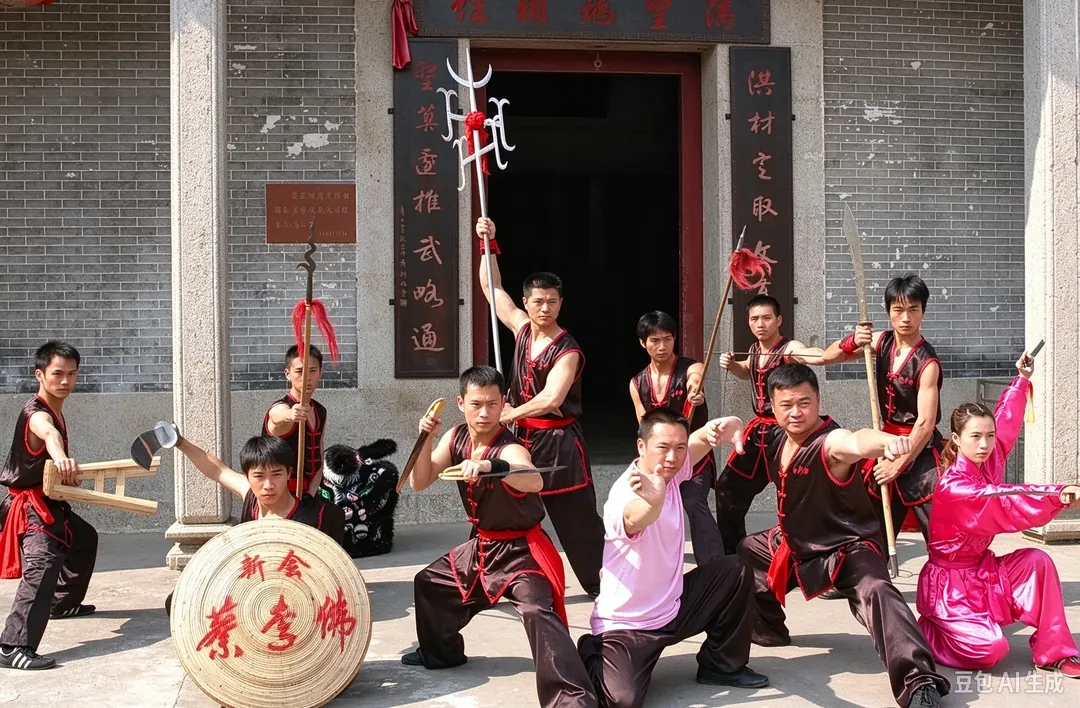
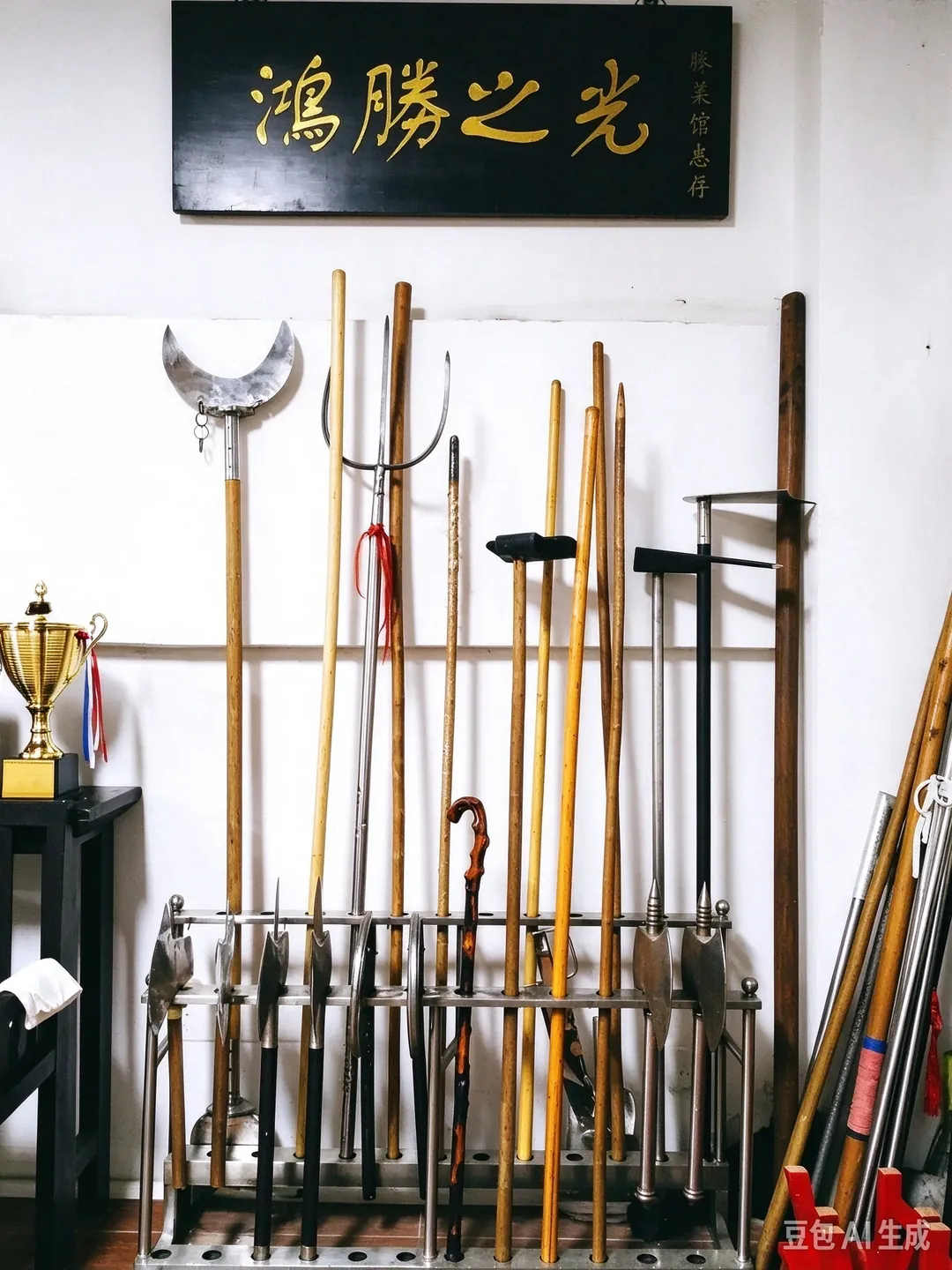
Forms of this class train the whole frame: the weapon extends the stance, and power must issue through a lever far longer than the arm.
The pa in Cantonese life
Around the weapons sits a folk culture. In the festival calendar of the Cantonese counties — the year-villages (年例) and the lion-dance processions — a pa team traditionally clears the road ahead of the lion; the three points carry incense in temple rites as an appliance that turns away harm. Every major southern system keeps pa sets, and the weapon’s presence on the festival ground is one reason it stayed in hand while rarer arms vanished.[7]
What survives, and what does not
The originals are gone. In the steel campaigns of the 1950s, the country’s metal weapons went into the furnaces, and the Nine Dragon Trident was among them — a loss shared across the whole of Lingnan martial culture.[1]
What stands today are replicas, rebuilt from the registers and the memory of elder teachers:
- Choy Li Fut Ancestral Kwoon, Jingmei village, Xinhui — the principal display, and the version the lineage treats as authoritative.[1][18]
- Hung Sing Memorial, Taishang Temple, Foshan — the Foshan line’s display.[2]
- Jiangmen museums and the intangible-heritage exhibition centers — folk displays.
No public collection is recorded as holding a Qing- or Republican-era original.
Seeing it today
In place of the lost originals stand film and transmission: the CCTV Explore · Discover documentary on Choy Li Fut (c. 2022) carries close footage and demonstration; the TVB travel series Road Notes (路筆拾遺, 2023, with Southern Media) put the trident on screen with an on-camera trial; practitioner demonstrations circulate on the video platforms.[15][16] Every branch of the system keeps a trident set in transmission; because the weapon is heavy and unfamiliar, it is taught late, and it travels abroad with the diaspora schools — the federation line among them.
The 1998 study, preserved
The original 1998 document was among the earliest English-language weapon studies on the web for this system. This page supersedes it editorially but preserves its address and its citation trail: the English Wikipedia article on Choy Li Fut cites it as a weapon reference, and the Portuguese Wikipedia cites it under the name Gau Lung Cha.[19][20] Corrections and better evidence are welcomed through the contact page.
Cautions
- Replicas only. No original trident survives the 1950s steel campaigns; every extant piece is a modern reconstruction, and the archive does not call a replica an original.
- “Chan Heung’s embodiment” is a school teaching — the trident is honored in the gate as an image of its founder, fierce and many-gifted; it is a homage, not a biography.
- The Shi Dakai unit is a recorded claim, thinly sourced — the death-defying unit appears in lineage and regional accounts, without the archival documentation a fuller history would want; the archive says “recorded,” not “documented.”
- No carved dragons. The name describes nine prongs, not decoration.
- Modeled on, not handed down from, Qi Jiguang — Chan Heung reworked the wolf-brush design two centuries after it was written down.
- Representative, not exclusive. Forks and pas live in other southern systems too; the trident is the most representative specialty weapon of Choy Li Fut, not a form no one else ever held.
- The three photographs are digitally restored. Every image on this page is an older print that has been cleaned up and repaired. Read them as views of the weapon’s structure and of a weapons display — not as evidence for the exact appearance of any surviving piece; faces, inscriptions and small fittings may not match the original print.
The record continues
The weapon belongs to the system founded at Choy Li Fut, devised by Chan Heung at the water garrisons of the late 1830s; the founder’s own record carries the register of arms. The archive’s account of how these materials reached the web — and how this page kept its address — is part of its history.
[1] Ancestral kwoon display and notes. [4] Guangdong Quandao, Nine Dragon Trident entry. [5] Chan Heung’s weapon register, gate-circulated. [6] Qi Jiguang, Jixiao Xinshu, wolf-brush chapter. [7] History of Guangdong Martial Arts. [8] Golden Eagle school materials, 1998–1999 (archived captures). [9] Zhanjiang anti-French materials, 1898. [10] Taiping history studies, weaponry of Shi Dakai’s force. [15][16] CCTV and TVB program records. [17] Jiangmen Culture & Tourism / Xinhui district government. [18] Jiangmen Intangible Heritage Protection Center; ancestral kwoon official site. [19][20] English and Portuguese Wikipedia citations of this address.
Sources & References
- Nine Dragon Trident display and notes 九龍叉陳列資料 — Choy Li Fut Ancestral Kwoon, Jingmei village, Xinhui, form, devising background, and history of use; replica on display (Primary Source)
- Weapons display of the Hung Sing Memorial 佛山鴻勝紀念館兵器陳列 — Foshan, Taishang Temple (Primary Source)
- Ancestral kwoon weapons register 始祖館館藏兵器譜 — 64 weapon sets of the Choy Li Fut corpus (Primary Source)
- Guangdong Quandao, Nine Dragon Trident entry 《廣東拳道》九龍叉條 — Lingnan martial history series (Primary Source)
- Chan Heung's weapon register, gate-circulated 陳享兵器譜傳抄本 — descendants' and disciples' transcription (Primary Source)
- Jixiao Xinshu, wolf-brush chapter 《紀效新書》狼筅篇 — Qi Jiguang, Ming dynasty, the historical prototype of the weapon (Historical Source)
- History of Guangdong Martial Arts 《廣東武術史》 — Guangdong People's Publishing House (Historical Source)
- Survey of Foshan Martial History 《佛山武術史略》 — Foshan Municipal Museum (Historical Source)
- Zhanjiang anti-French materials 湛江抗法史料 — 1898; three-pronged pa in battle (Historical Source)
- Taiping history studies: weaponry of Shi Dakai's force 太平天國史研究 — recorded nine-trident death-defying unit (Historical Source)
- Chart of Chinese Arms Old and New 《中華古今兵械圖考》 — fork-class entries (Secondary Source)
- State Council second batch of national intangible heritage (2008) 國務院第二批國家級非遺 — Choy Li Fut, Ⅵ-36 (Secondary Source)
- Jiangmen Intangible Heritage Protection Center 江門市非遺保護中心 — jmswhg.cn · www.jmswhg.cn (Secondary Source)
- Ancestral kwoon official site 蔡李佛始祖拳會官網 — choyleefut.com · www.choyleefut.com (Secondary Source)
- CCTV Explore · Discover, Choy Li Fut episode 央視《探索·發現》 — c. 2022; close footage and demonstration of the trident (Secondary Source)
- TVB "Road Notes" Choy Li Fut episode 《路筆拾遺》 — 2023, with Southern Media; on-screen demonstration (Secondary Source)
- Baidu Baike entry 蔡李佛拳 — baike.baidu.com, the 64-set weapon list of the heritage curriculum, in which the Nine Dragon Trident is number 45; its category totals do not always agree with its own item lists · baike.baidu.com (Secondary Source)
- Jiangmen Culture & Tourism / Xinhui district government — ancestral kwoon introduction; rare founder manuscripts and weapons (Secondary Source)
- Choy Li Fut — References — English Wikipedia, cites "9 Dragon Trident - Golden Eagle Martial Arts Center" · en.wikipedia.org (Secondary Source)
- "9 Dragon Trident (Gau Lung Cha)" — Choy lay fut, Wikipédia (Portuguese Wikipedia), cites this page as a weapon reference (Secondary Source)
- Photographs on this page 九龍叉與兵器陳列照片 — older prints, digitally cleaned and repaired, trident head detail; Choy Li Fut weapons display; Hung Sing memorial weapons rack (Primary Source)
Related Knowledge
People
- Chan HeungChan Heung (1806–1875), courtesy name Ziying, founded Choy Li Fut in 1836 under teachers Chan Yuen Wu, Li Yau San, and Choy Fook. Life, lineage, and sources.
Traditions
- Choy Li FutChoy Li Fut is a southern Chinese martial art founded by Chan Heung in 1836. It blends northern and southern methods; its history, lineage, forms, and weapons.
Concepts
- Ten Animal Forms The ten animal forms (十形拳) of Choy Li Fut — each shape with its own intent and power method, from the dragon's spirit to the biao's savagery.